
Posted by LightbulbWholesaler.com on 21st Oct 2026
For decades, incandescent lightbulbs have been a familiar sight in homes and businesses, providing the warm glow people have relied on for daily lighting. But as energy costs rise, many buyers are looking for a more efficient alternative. That’s where LED light bulbs come in. They produce the same level of brightness while using significantly less electricity, making them an appealing option for anyone looking to reduce energy consumption.
So, does switching to LEDs really make a noticeable difference to your electricity bills? And are incandescent bulbs still worth considering for certain lighting needs?
If you’re comparing both options before making a purchase, it helps to understand how they perform in terms of energy use, running costs, brightness, and lifespan. This blog will explore the key differences between LED and incandescent bulbs to help you choose the right lighting for your home or business.
How Do LED and Incandescent Bulbs Produce Light Differently?
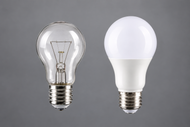
Although LED and incandescent bulbs can provide similar brightness, they use different technologies to produce light. These differences help us understand how one type of bulb can be so much more efficient with respect to electricity usage.
Incandescent light bulbs produce light by passing an electric current through a thin wire filament, heating it until it glows. The process creates light, but it also generates a considerable amount of heat. Much of the electricity consumed goes towards producing heat rather than useful light, making these bulbs less energy-efficient.
LED light bulbs, on the other hand, use light-emitting diodes to convert electricity into light. They generate far less heat during operation, allowing more of the energy they consume to produce illumination. This efficiency is one reason LEDs are becoming increasingly popular. The US LED lighting market is estimated to reach $20.18 billion in 2026, from $ 19.22 billion in 2025. This growth reflects the increasing demand for LED lighting across residential and commercial settings.
For commercial spaces, choosing lighting that uses less electricity can help reduce ongoing energy costs. Let’s compare both more closely.
LED vs Incandescent Bulbs: Which Uses Less Electricity?
LED light bulbs and incandescent light bulbs can provide similar brightness, but LEDs use significantly less electricity and last longer. Here’s how they compare in terms of energy use, running costs, heat generation, and lifespan.
|
Feature |
LED Light Bulbs |
Incandescent Lightbulbs |
|
Energy Consumption (Wattage) |
Typically use 8-10 watts to produce light similar to a 60-watt incandescent bulb. |
Usually require around 60 watts to provide the same brightness. |
|
Brightness (Lumens) |
Offer a range of brightness levels, with around 800 lumens being typical for a 60-watt replacement. |
A traditional 60-watt incandescent bulb produces approximately 800 lumens. |
|
Electricity Cost |
Cost less to operate because they consume fewer watts. |
Cost more to operate due to higher energy consumption. |
|
Energy Efficiency |
Convert a greater share of the electricity they use into visible light. |
Waste more energy as heat during operation. |
|
Annual Energy Usage |
A 9-watt LED used for 3 hours daily consumes around 9.9 kWh per year. |
A 60-watt incandescent used for 3 hours daily consumes around 65.7 kWh per year. |
|
Heat Generation |
Produces comparatively little heat, helping keep the area around the bulb cooler. |
Generates considerably more heat while switched on. |
|
Lifespan |
Many household LED bulbs are rated for around 15,000 to 25,000 hours, depending on the product. |
Often last around 750 to 1,000 hours. |
The savings can become more noticeable when you replace several bulbs throughout your home or business. However, your actual cost savings depend on your electricity rate and how often the lights are used.
How Much Can You Save on Electricity Bills by Switching to LED Bulbs?
If you are using many light bulbs each day, switching to LED light bulbs could help lower your electric bill. For instance, a 9-watt LED bulb can provide brightness comparable to a 60-watt incandescent bulb while using around 85% less electricity, depending on the specific products being compared.
Let's look at a simple example to understand the potential savings.
- Annual electricity costs
A 9-watt LED uses about 9.9 kWh annually when used for 3 hours daily, compared with 65.7 kWh for a 60-watt incandescent bulb.
- Energy consumption comparison
The LED uses around 85% less electricity while delivering similar brightness.
- Savings across multiple bulbs
Replacing 10 incandescent bulbs with comparable 9W LEDs could save around $89 annually, assuming each bulb is used for three hours a day and electricity costs $0.16 per kWh. Actual savings will vary by electricity rate and usage.
Which Bulb Should You Choose for Your Home or Business?
The right bulb depends on where you plan to use it, how much lighting you need, and your budget. For most everyday applications, LED light bulbs offer a practical balance of energy efficiency, brightness, and long-term value.
- Home vs. business lighting needs
LEDs are great for use in many types of locations, including: Living Rooms; Kitchens; Bedrooms; Offices; Retail Stores; Warehouses. They have a long life expectancy, which makes them very beneficial in areas where the lights will be turned on for long periods of time.
- Energy efficiency and cost
Switching from incandescent bulbs to LEDs can help reduce lighting-related electricity costs. While an initial investment in incandescent bulbs will likely result in a lower purchase cost than that of LEDs, over time, the increased power usage and decreased lifespan of incandescent bulbs will likely create higher operating expenses for you.
- Brightness and bulb applications
Determine how much light is needed to illuminate your room correctly by reviewing the lumen level. Cooler white lights are best suited for task-oriented environments like work stations and workshops, whereas warm white LEDs are ideal for bedroom and living spaces.
- Explore LED and incandescent bulbs
Before making a purchase, consider the following specifications of each light bulb: wattage, brightness, shape of the bulb, base type, and whether or not it is compatible with a dimmer switch. Explore Light Bulb Wholesaler's range of LED and incandescent bulbs to compare wattage, brightness, bulb shape, base type, and dimmer compatibility before choosing the right option for your needs.
Final Thoughts
Choosing energy-efficient bulbs can reduce the electricity used for everyday lighting. Although incandescent light bulbs are adequate for general lighting purposes, LED light bulbs provide a higher level of energy efficiency, a longer lifespan, and more value over time. To determine which is the most suitable option for your home or business, compare what types of lighting you need, how much you want to pay, and how often you plan to use those lights.
FAQs
Q1. How long do LED bulbs last compared with incandescent bulbs?
Ans. Many household LED bulbs are rated for 15,000 to 25,000 hours or more, while traditional incandescent bulbs often last around 750 to 1,000 hours.
Q2. Do LED bulbs produce less heat than incandescent bulbs?
Ans. Yes. LEDs generally release less heat than incandescent bulbs producing comparable light output.
Q3. Can LED bulbs replace incandescent bulbs in existing fixtures?Ans. Yes, provided the LED bulb has a compatible base, suitable dimensions, and the correct voltage rating. Check dimmer compatibility if the fixture uses a dimmer switch.
Q4. How do I choose the right LED bulb to replace a 60-watt incandescent bulb?
Ans. Look for an LED bulb rated at around 800 lumens, and check if its base type and dimensions match your existing fixture.